Key takeaways
- California's plumbing code requires a pressure regulator when static pressure exceeds 80 psi.
- You can check your pressure with an inexpensive gauge on an outdoor hose bib in a few minutes.
- Regulators wear out — commonly in 10 to 15 years — and a failing one can let pressure rise.
- Keeping pressure in range is a sensible preventive step, but it is only one factor in slab leaks.
In this article
Most homeowners never think about their water pressure until a faucet starts dripping, pipes bang, or a leak appears. Yet pressure is one of the few slab-leak risk factors you can actually measure and control yourself. This guide explains what "high" pressure means, how to test it safely, and what to do if your readings are out of range.
Why water pressure matters for your pipes
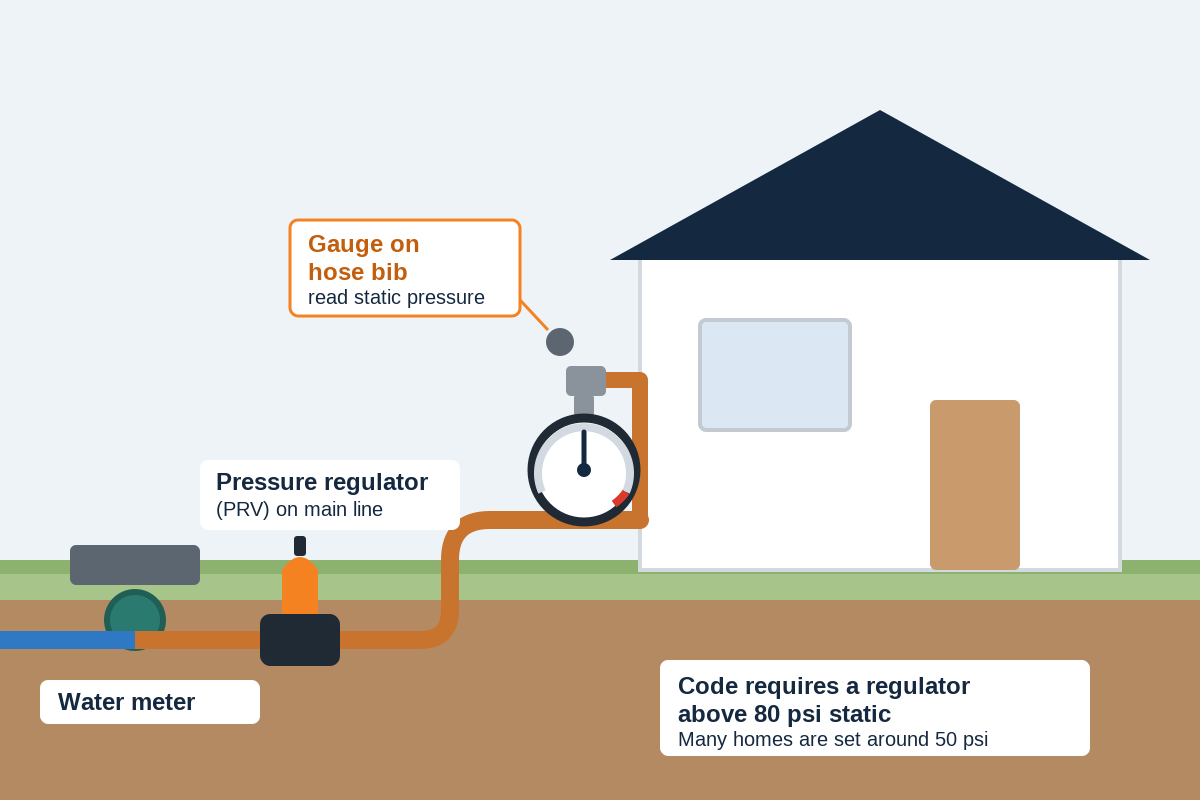
Water pressure is the force pushing water through your plumbing. Utilities often deliver water at higher pressure than a house needs, so many homes have a pressure regulator (also called a pressure-reducing valve, or PRV) on the main line to bring it down.
When pressure is too high, every pipe, joint, valve, and appliance connection works harder all the time. Sudden pressure spikes — the banging you may hear when a valve closes quickly — add short bursts of extra stress. Over years, that strain can contribute to leaks, alongside other factors like corrosion and abrasion that we explain in what causes slab leaks.
The 80 psi rule in California
The California Plumbing Code requires a pressure regulator where static water pressure is more than 80 pounds per square inch. The City of San Diego's utility guidance summarizes it simply: a regulator is required when pressure is "more than 80 pounds per square inch (psi)", and "regulators are the responsibility of the property owner."
As for a target setting, Rainbow Municipal Water District notes that homeowners typically set regulators around 50 psi and describes 30 to 80 psi as a general range for household plumbing.
How to test your water pressure
You need a screw-on water pressure gauge, which Eastern Municipal Water District notes you can buy at a hardware store for about $10.
- Pick an outdoor hose bib close to where water enters the house, after the regulator.
- Turn off water use inside and outside — faucets, irrigation, washer, dishwasher — to read static pressure.
- Screw the gauge on by hand and open the hose bib fully.
- Read the gauge. Note the number and close the bib.
- Repeat at another hose bib and at a different time of day; pressure can vary, especially overnight when demand is low.
- Optional: test with water running. EMWD suggests checking with and without water running inside; a drop of about 5 psi is generally acceptable, while a much larger drop may point to a pressure problem.
Watch for creep. Some gauges have a "lazy hand" that records the highest reading. If the maximum overnight reading is well above your daytime reading, a regulator may not be holding pressure — a common sign of wear.
What your readings mean
| Static reading | What it may mean | Suggested step |
|---|---|---|
| Below 30 psi | Low pressure; possible regulator, supply, or leak issue | Check other fixtures; ask a plumber or your water provider |
| About 40–60 psi | Within the range many homeowners aim for | Recheck occasionally |
| 60–80 psi | Higher, but within the code limit | Consider having the regulator setting checked |
| Above 80 psi | Exceeds the level at which code requires a regulator | Have a licensed plumber assess or install a regulator |
| Rises over time or overnight | Regulator may be failing | Have the regulator inspected or replaced |
General guidance; your plumber may recommend a specific setting for your home and fixtures.
Signs a pressure regulator may be failing
Rainbow Municipal Water District lists several warning signs: declining or fluctuating pressure, no pressure, banging or vibrating noises in the walls, and pressure that is too high — which can show up as leaks or a constantly running toilet. It also notes that regulators most commonly last 10 to 15 years.
- Banging or rattling pipes when fixtures shut off
- Faucets that drip or toilets that run without explanation
- Pressure that is much higher at some times than others
- Appliance supply hoses or connections leaking repeatedly
- A regulator that is old, corroded, or has never been checked
Pressure and leak detection
Pressure also plays a role in finding leaks. A simple pressure-loss test is one of the first steps in confirming a hidden supply leak: EPA WaterSense guidance describes attaching a gauge, shutting off the main valve, and checking that pressure remains constant after 5 to 10 minutes — a drop indicates a leak. Professionals extend this by isolating hot and cold lines to see which one is losing pressure. See hot vs. cold water slab leaks.
What to do if your pressure is high
- Recheck at a couple of hose bibs and times of day to confirm.
- Call a licensed plumber to assess the regulator — adjustment, repair, or replacement.
- Look for existing leaks. If pressure has been high for a while, run a meter check: our guide to checking for unexplained water usage explains how.
- If the meter moves with everything off, arrange a leak location assessment before the problem shows up on your floor.
The bottom line
High water pressure will not explain every slab leak, but it is a risk factor you can measure in minutes with a $10 gauge. Keep static pressure within code — under 80 psi, with many homes set around 50 — and have an aging or unstable regulator checked. If you already suspect a hidden leak in the Whittier area, contact Precision Slab Leak Detection.
Concerned about a possible slab leak in Whittier? Call Precision Slab Leak Detection at (562) 358-3136 to talk through what you are noticing and how an assessment would work for your property.
Frequently Asked Questions
High pressure is one of several factors that can stress pipes, joints and fixtures, and keeping pressure within a normal range is a sensible preventive step. Slab leaks usually result from a combination of factors, such as corrosion, abrasion and installation details, so high pressure alone does not explain every leak.
Guidance varies, but California's plumbing code requires a pressure regulator when static pressure exceeds 80 psi, and some water districts note that many homeowners set regulators around 50 psi. Rainbow Municipal Water District describes 30 to 80 psi as a general range for household plumbing.
Rainbow Municipal Water District says the life expectancy of a pressure regulator is most commonly 10 to 15 years, though some fail sooner and others last longer. A regulator that is failing can let pressure creep up.
In California, the regulator is generally on the customer's side of the meter and is the property owner's responsibility to install and maintain. Your water provider can often tell you the typical pressure in your neighborhood.
Many regulators have an adjustment screw, but adjusting an old or corroded regulator can cause problems. If your readings are high or unstable, the safest approach is to have a licensed plumber assess and adjust or replace it.
Sources
- City of San Diego Public Utilities. Water Pressure.
- Eastern Municipal Water District. How to Check Your Water Pressure (January 2018).
- Rainbow Municipal Water District. Water Pressure Regulator FAQs.
- U.S. Environmental Protection Agency. Free of Leaks — Technical Reference Manual for WaterSense Labeled Homes (EPA-832-F-23-016, July 2023).
This article is general educational information, not a diagnosis of any specific property or professional plumbing, legal, insurance, or health advice. Conditions vary; consult qualified professionals for your situation.