Key takeaways
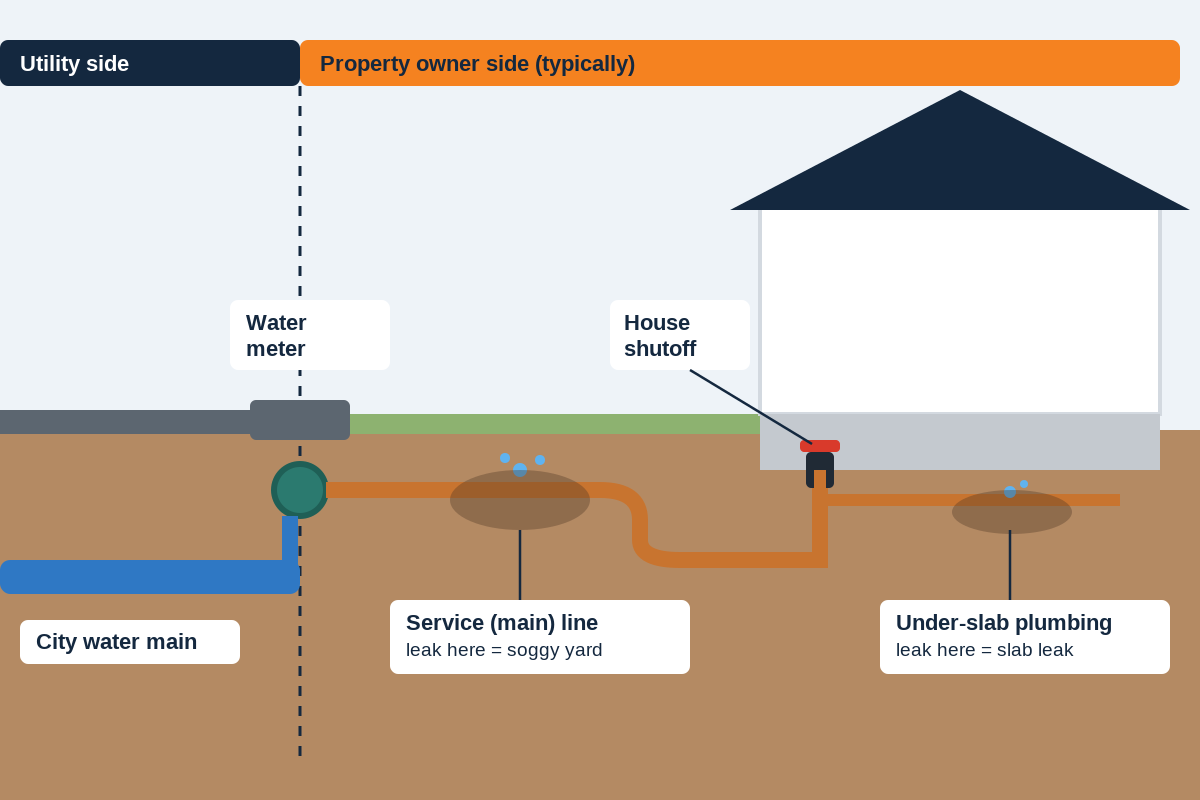
- Hidden leaks often fall into two groups: the main water (service) line in the yard, and lines under the slab.
- A simple test with the house shutoff valve and the water meter can tell you which side the leak is on.
- Pipes on your side of the meter are generally the property owner's responsibility; the utility generally handles its side.
In this article
When the water meter keeps spinning and you cannot find a drip anywhere in the house, it is natural to assume a slab leak. But there is another common hiding place: the buried pipe that carries water from the meter to your home. Telling the two apart early saves time, avoids calling the wrong specialist, and can keep you from opening up the wrong floor or yard.
Two places a hidden leak can be
1. The main water line (service line)
This is the buried pipe from the meter — usually in a box near the curb or sidewalk — to the point where water enters your home, often near a hose bib or a main shutoff valve. It runs under lawn, driveway, or walkway rather than under the house.
2. Plumbing under the slab
Once inside the house, supply lines branch out to fixtures. In many slab-on-grade homes, some of those lines run beneath or within the concrete foundation. A leak there is a slab leak. For other possibilities inside the home — fixtures, walls, drains — see how to tell a slab leak from other plumbing leaks.
Signs of a main water line leak
- A soggy or unusually green patch of lawn along the line between the street and the house, even in dry weather
- Water pooling or seeping near the meter box, driveway edges, or walkway
- Sinking or cracked pavement along the pipe route
- Lower water pressure throughout the whole house
- A water meter that moves even with the house shutoff closed
Signs that point under the slab instead
- Warm or damp areas on interior floors
- Musty odors, loose tile, or swollen wood flooring
- The sound of running water inside when nothing is on
- A water heater running more than usual (for hot-water lines)
- A meter that stops moving when the house shutoff is closed
For the full list of indoor symptoms, read 10 signs of a slab leak.
The shutoff-valve test: which side is leaking?
This test works if your home has a main shutoff valve where the line enters the house, and the valve turns easily. Do not force a stiff or corroded valve.
- Turn off all water use inside and outside, including irrigation and the ice maker.
- Check the meter's low-flow indicator. Meters can show very small flows; as the City of Hayward explains, movement while your water is off suggests a leak on the property.
- Close the house's main shutoff valve.
- Watch the meter for several minutes. The City of Healdsburg suggests a 30-minute no-use period for a meter check if you can manage it.
- Interpret the result:
- Meter still moving → the leak is likely between the meter and the house shutoff (main line), or on an irrigation line that branches off before the shutoff.
- Meter stopped → the leak is likely inside the home's plumbing, which is where slab leaks occur.
- Reopen the shutoff when you finish.
Irrigation caution. In many Southern California homes, irrigation lines branch off the main line before the house shutoff. If the meter keeps moving, check the irrigation system and its valves before concluding the main line is leaking.
Who is responsible for repairs?
Water providers set their own policies, but the common arrangement is:
- Street side of the meter: the utility. East Bay Municipal Utility District, for example, states it is responsible for leaks on the street side of the meter and for the meter itself.
- Customer side of the meter: the property owner. The same utility notes that "any pipe repairs on the customer's side of the meter are the customer's responsibility."
- Inside the home, including under the slab: the property owner (or, in rentals and condos, as set by the lease or CC&Rs — see slab leaks in condos and apartments).
Water service in and around Whittier is not provided by a single utility, so check your water bill for your provider's name and ask about its policies, leak alerts, or billing adjustments.
Why a hidden leak adds up
Any leak after the meter is billed, whether it is in the yard or under the house. The EPA estimates the average household's leaks can waste more than 9,300 gallons of water every year. A pressurized service-line or slab leak runs around the clock, so finding it promptly matters.
What to do next
- Run the shutoff-valve test to see which side of the house shutoff the leak is on.
- If it points to the yard, check irrigation first, then contact a licensed plumber or your water provider for the main line.
- If it points inside, rule out toilets and fixtures — our water usage guide explains how — and then arrange slab leak detection to locate the leak.
- Check your pressure. Unusually high pressure can stress both the main line and interior plumbing; see how to test your water pressure.
The bottom line
A spinning meter with no visible leak usually means one of two things: a leak in the buried line between the meter and the house, or a leak inside — often under the slab. A five-minute shutoff-valve test can tell you which, and that tells you who to call. If the evidence points under your floor in the Whittier area, contact Precision Slab Leak Detection to talk through the next step.
Concerned about a possible slab leak in Whittier? Call Precision Slab Leak Detection at (562) 358-3136 to talk through what you are noticing and how an assessment would work for your property.
Frequently Asked Questions
It is the buried pipe — often called the service line — that carries water from the water meter, usually near the street, to your house. The portion on your side of the meter is typically the property owner's responsibility.
If your home has a main shutoff valve where the line enters the house, close it and watch the water meter. If the meter still moves, the leak is likely between the meter and the house. If it stops, the leak is likely inside the home's plumbing, which is where slab leaks occur.
Utilities generally repair leaks on their side of the meter, and property owners are generally responsible for pipes on the customer's side. East Bay Municipal Utility District, for example, states that pipe repairs on the customer's side of the meter are the customer's responsibility. Check your own water provider's policy.
Yes. Water that leaks after the meter passes through it and is billed, even though it never reaches your fixtures. A steady service-line leak can add up quickly.
Our focus is slab leak detection and leak-location diagnostics. If you are unsure where your leak is, call us and describe what you are seeing; we will help you work out the likely location and the right next step.
Sources
- East Bay Municipal Utility District. What is EBMUD's responsibility regarding repairing leaks at a water meter?.
- City of Hayward, California. How to Read Your Water Meter.
- City of Healdsburg, California. Read Your Water Meter and Identify Leaks.
- U.S. Environmental Protection Agency, WaterSense program. Fix a Leak Week.
- U.S. Environmental Protection Agency. Free of Leaks — Technical Reference Manual for WaterSense Labeled Homes (EPA-832-F-23-016, July 2023).
This article is general educational information, not a diagnosis of any specific property or professional plumbing, legal, insurance, or health advice. Conditions vary; consult qualified professionals for your situation.